
Progressive Overload: The 5 Best Ways to Build Muscle and Strength Faster
Learn the 5 most effective progressive overload strategies for muscle growth so you can break plateaus, build size faster, and stop relying solely on heavier weight.
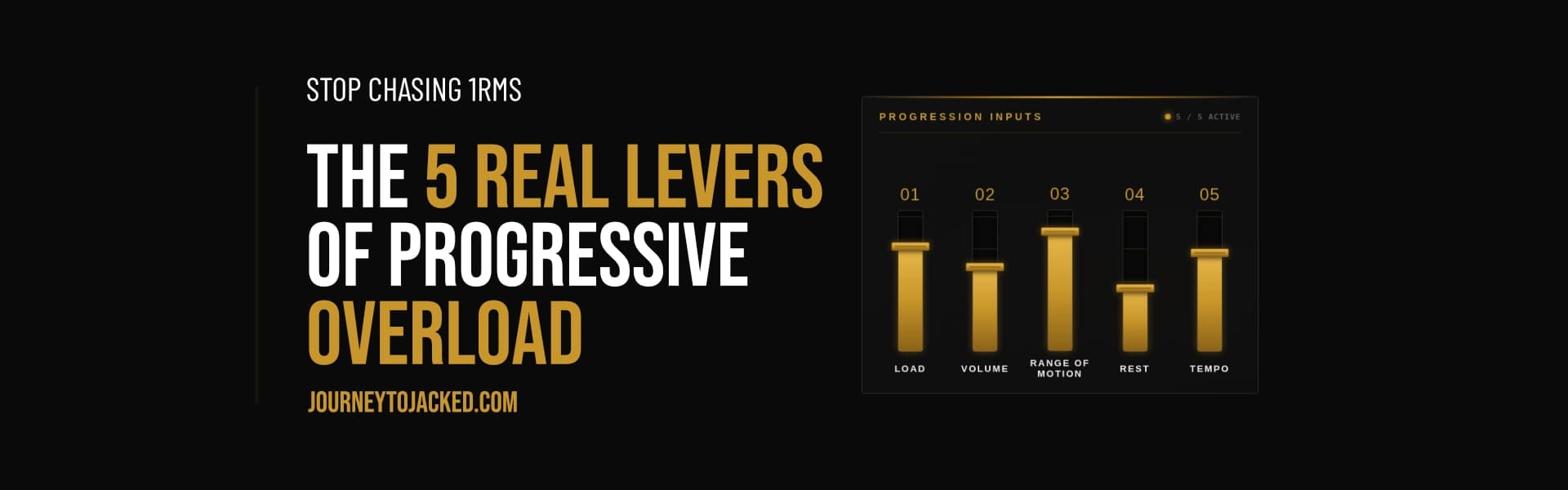
Stop Chasing 1RMs: 5 Real Levers of Progressive Overload
Most lifters are pulling one lever when there are five. That gap is exactly why progress dies.
What is progressive overload? Progressive overload is the gradual increase of training stress over time through load, reps, volume, density, or technique to force adaptation.
Progressive overload is the foundation of building muscle. Every serious lifter knows this. And yet most intermediate trainees reduce it to a single thing: add weight to the bar, forever.
That works until it stops working. When the weights stop moving week over week, most people panic. They get sloppy chasing PRs, or they tell themselves they've hit their genetic ceiling.
They haven't. They've just been pulling one lever when there are five.
The 5 Levers of Progressive Overload
- Increase Load (The One Everyone Knows)
- Increase Volume (More Total Work Over Time)
- Increase Range of Motion (The Most Overlooked Lever)
- Rest Period Reduction (Same Work, Less Time)
- Tempo and Time Under Tension (Change the Stimulus)
Lever 1: Load (The One Everyone Knows)
Yes, adding weight is progressive overload. But it has rules.
Add load only when you've fully mastered the top of your rep range with clean form. Grinding out three ugly reps and jumping weight is not progression. It's ego lifting. It leads to stalls and injury.
How to apply it: When you hit the top of your rep range (e.g., 3x8) with solid form for two consecutive sessions, add the smallest increment available. Fractional plates are not cheating. They're smart.
Lever 2: Volume (More Total Work Over Time)
Your muscles don't only respond to heavier weight. They respond to more total work.
Adding a set to your working block over a training cycle is progressive overload. Going from 3x8 to 4x8 at the same load is progress. Do not underestimate it.
How to apply it: Add one working set every 2 to 3 weeks per movement during an accumulation block. Then deload and reset.
Lever 3: Range of Motion (The Most Overlooked Lever)
A full-range rep at 80% of your max creates more mechanical tension and muscle damage than a partial rep at 90%.
If you've been quarter-squatting or doing half-rep curls, achieving true full range of motion at your current weight is a legitimate form of progression. Most people skip this one entirely.
How to apply it: Film your sets. Demand honest full ROM. Hips below parallel. Full bicep stretch. Chest to bar. Then progress load from that standard only.
Lever 4: Rest Period Reduction (Same Work, Less Time)
Doing the same work in less time is progression.
If you complete 4x10 bench press with 3 minutes rest this week and hit the same 4x10 with 2 minutes 15 seconds rest in four weeks, your work capacity has improved. Your muscle's ability to sustain tension has improved. That is progress.
How to apply it: Track your rest periods. Shave 10 to 15 seconds off over a block. Use this lever when load increases are stalling.
Lever 5: Tempo and Time Under Tension (Change the Stimulus)
The speed of a rep changes the stimulus dramatically.
A 3-second eccentric on a squat doubles the time your quads spend under load compared to dropping down in 1 second. Same weight. Same reps. Significantly harder stimulus.
How to apply it: Add a 3 to 4 second eccentric to your main compounds for 4 to 6 weeks. You'll need to drop weight. That's the point. Work back up and you've created a new overload cycle.
How to Structure These Levers in a Training Block
You don't chase all five at once. Think in phases:
Accumulation Phase (6 to 8 weeks) Focus on Volume and Range of Motion. Build your work capacity. Weights increase modestly.
Intensification Phase (4 to 6 weeks) Load becomes the focus. Strip some volume. Push top sets harder.
Deload (1 week) Drop volume and intensity. Recover. Come back stronger.
Within each phase, use Rest Period Reduction and Tempo as secondary dials. Especially when primary metrics plateau mid-block.
Journey To Jacked Fitness Plans does exactly that. No guesswork. No wasted training blocks. Just a structured system built around your level, your goals, and your schedule. Your Tailored Fitness Blueprint Here
Summary Table: The 5 Levers of Progressive Overload
| Lever | Primary Goal | Example Progression | Best For |
|---|---|---|---|
| Load | Increase resistance | Bench Press: 185 lbs → 190 lbs | Max strength, mechanical tension |
| Volume (Reps/Sets) | Increase total workload | 3x8 → 4x8 or 3x8 → 3x10 | Hypertrophy, work capacity |
| Range of Motion | Increase movement challenge | Half squat → Full-depth squat | Mobility, muscle stimulus, joint strength |
| Rest / Density | Increase workload efficiency | Rest: 90 sec → 60 sec | Conditioning, hypertrophy, endurance |
| Execution (Tempo + Time Under Tension) | Improve stimulus quality | 2-sec eccentric → 4-sec eccentric | Muscle control, hypertrophy, technique |
Bottom Line
Progressive overload is not one-dimensional.
If you only focus on adding weight, you miss multiple opportunities for growth.
Mastering all 5 levers allows you to drive muscle and strength gains more sustainably, break plateaus faster, and create progression even when load cannot increase.
That's the journey. Keep going.
Your Next Step
Stop guessing. Start building.
Get a personalised training plan built around your body, your goals, and your schedule — ready in minutes, yours forever.
Get Your Plan