
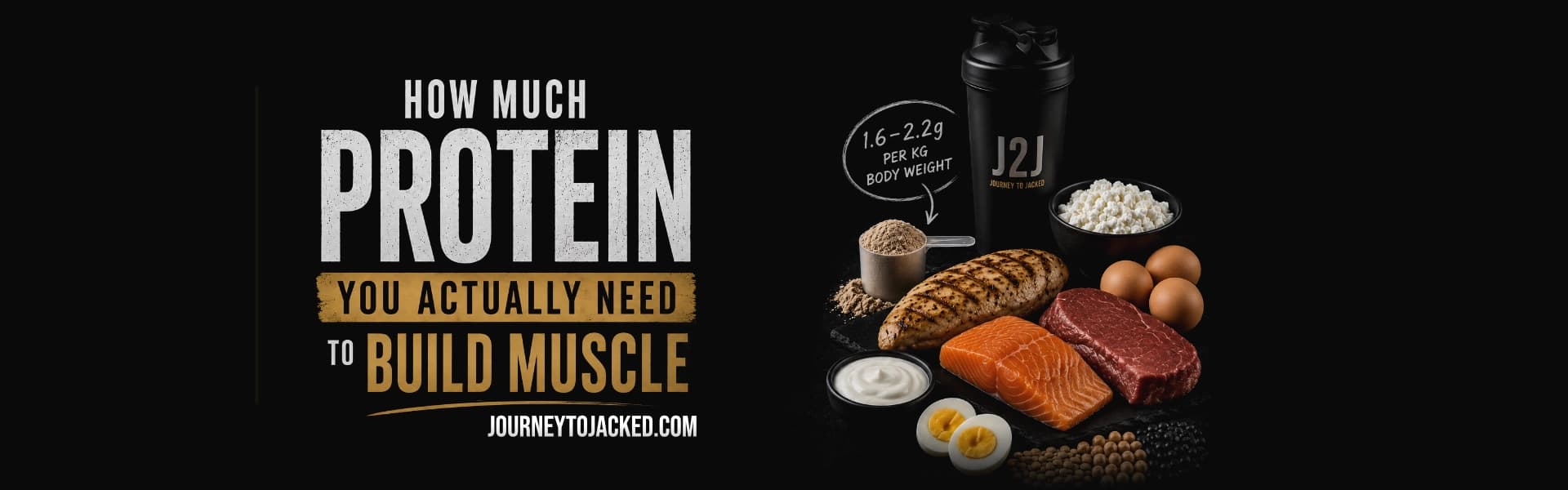
How Much Protein You Actually Need to Build Muscle
The real number for building muscle is 1.6 g per kg of bodyweight, not the inflated figure supplement ads push. Here is what the science says.
Every supplement label tells you to eat more protein. More shakes, more bars, more scoops. The number they push is built to sell tubs, not build muscle.
The real number is lower than you think. And once you hit it, more does almost nothing.
How much protein do you need to build muscle?
To build muscle, eat 1.6 grams of protein per kilogram of bodyweight per day. A large meta-analysis found gains plateau at this point, with no extra muscle past roughly 1.6 g/kg 1. For a 80 kg lifter, that is about 128 grams per day.
That is the ceiling for most people. Eating double does not double your results. It just makes expensive urine.
Why the supplement number is wrong
Supplement ads quote 2.2 g/kg or higher. Some push 1 gram per pound, which lands near 2.2 g/kg for most lifters.
That figure is not a lie. It is a safe upper margin sold as a requirement. Hitting it means buying more powder. The incentive is obvious.
The research tells a cleaner story. Past 1.6 g/kg, the curve flattens. Your muscles can only use so much protein for growth at a time.
Does eating more protein build more muscle?
No. Past about 1.6 g/kg of bodyweight, extra protein does not add muscle. The body uses surplus protein for energy or stores it, not for extra growth. Training stimulus, total calories, and consistency drive size from there.
This matters because protein is the most expensive macro. Chasing a number you do not need wastes money and crowds out carbs that fuel your lifts.
What about a cut?
When you diet, protein needs rise. Aim for 1.8 to 2.2 g/kg in a deficit to protect muscle while you lose fat. Higher protein in a cut also keeps you full and holds onto hard-won size.
If you are deciding how to structure your surplus or deficit, read Lean Bulk vs Dirty Bulk first.
How to hit your protein number
Stop guessing. Build it into a few anchor meals and the total takes care of itself.
- Set the target. Bodyweight in kg times 1.6. That is your daily floor.
- Anchor each meal with protein. Aim for 30 to 40 grams per meal across 3 to 4 meals.
- Use whole foods first. Chicken, eggs, beef, fish, dairy, legumes. Powder fills gaps, it does not replace meals.
- Track for two weeks. Most people wildly overestimate their intake. Measure once, then you know.
Per-meal distribution helps. Spreading protein across the day supports muscle protein synthesis better than one giant dinner 2.
Want your exact targets dialed to your bodyweight and goal? Run the numbers with our free macro calculator.
If you are just starting out, the full foundation is in How to Build Muscle as a Beginner.
The bottom line
Protein builds muscle. But the amount you need is fixed and modest, not endless. Hit 1.6 g/kg, train hard, eat enough total calories, and the protein side is handled.
Everything past that number is marketing.
Your Next Step
Stop guessing. Start building.
Get a personalised training plan built around your body, your goals, and your schedule — ready in minutes, yours forever.
Get Your PlanReferences
Footnotes
-
Morton, R. W., et al. (2018). A systematic review, meta-analysis and meta-regression of the effect of protein supplementation on resistance training-induced gains in muscle mass and strength in healthy adults. British Journal of Sports Medicine, 52(6), 376-384. https://doi.org/10.1136/bjsports-2017-097608 ↩
-
Schoenfeld, B. J., & Aragon, A. A. (2018). How much protein can the body use in a single meal for muscle-building? Implications for daily protein distribution. Journal of the International Society of Sports Nutrition, 15, 10. https://doi.org/10.1186/s12970-018-0215-1 ↩